01
What we heard
The leadership question was simple but hard to answer: which acquisition sources created customers who actually completed onboarding and used the product?
Full-funnel measurement and AI-led audience prioritization across a complex conversion journey.
Long approval cycles and fragmented attribution made it difficult to distinguish cheap leads from customers likely to activate.
We fed downstream activation signals back into media, rebuilt audience prioritization, and aligned every campaign to quality-adjusted acquisition cost.
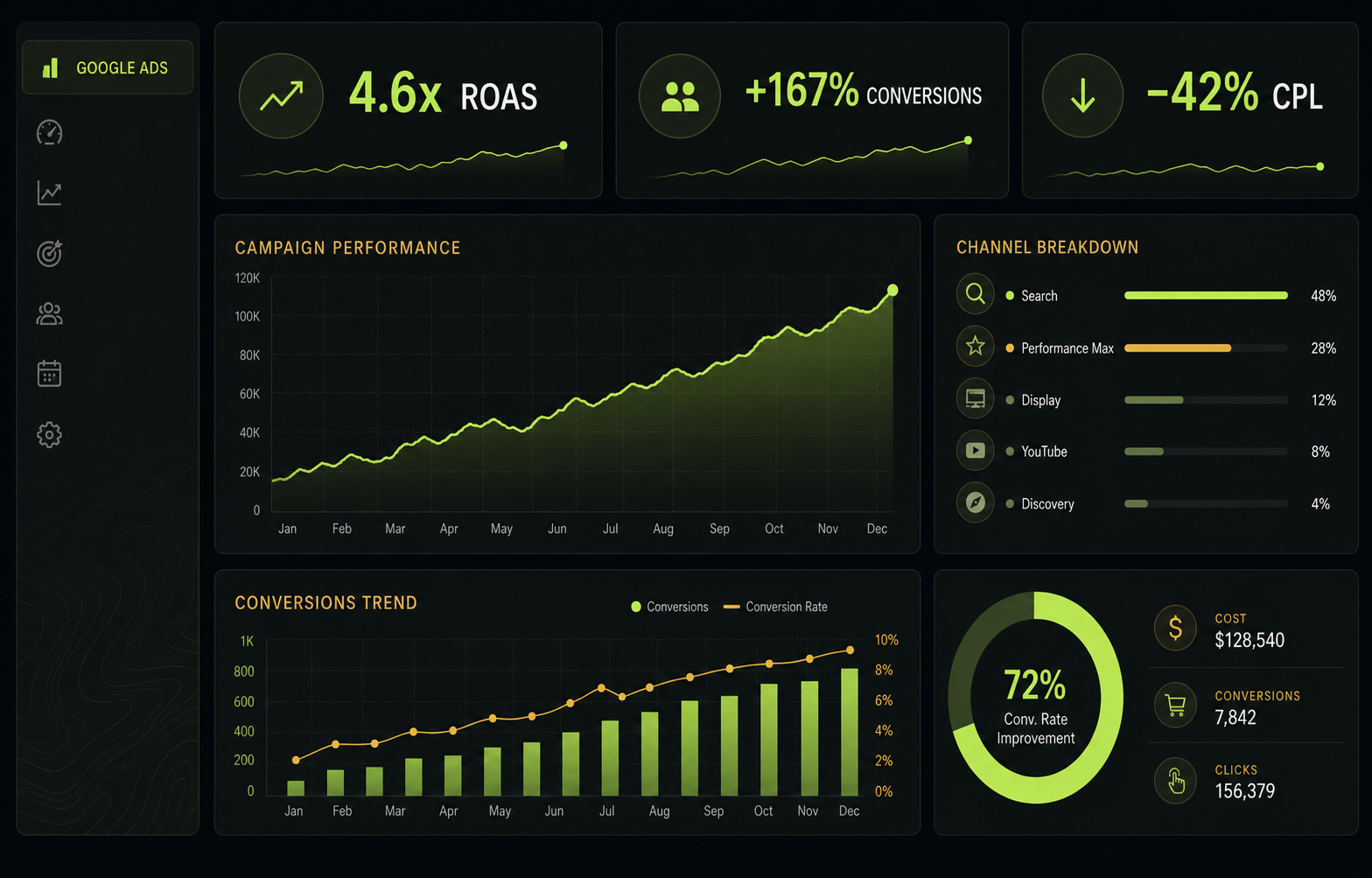
Google Ads Snapshot
A representative campaign snapshot showing the shift from inexpensive leads to quality-adjusted acquisition, with activation data guiding bidding and audience prioritization.
Representative visualization · Results shown are from this engagement
The work moved through three connected stages: listening closely enough to find the real constraint, operating as one team, and turning evidence into a decisive breakthrough.
What we heard
The leadership question was simple but hard to answer: which acquisition sources created customers who actually completed onboarding and used the product?
How we collaborated
Product, compliance, analytics, and growth worked through a biweekly experiment council. This kept measurement changes compliant and made each campaign decision traceable to a product behavior.
The breakthrough
Activation events revealed that the cheapest lead segments were also the least valuable. Reweighting the system toward quality reduced apparent volume before producing stronger economics.
Each workstream had an owner, an evidence standard, and a clear connection to the commercial outcome. This kept execution fast without turning the engagement into disconnected tactics.
Unified product, CRM, and media conversion events
Modeled high-propensity audience characteristics
Built channel-specific education journeys
Optimized to activated customers rather than form fills